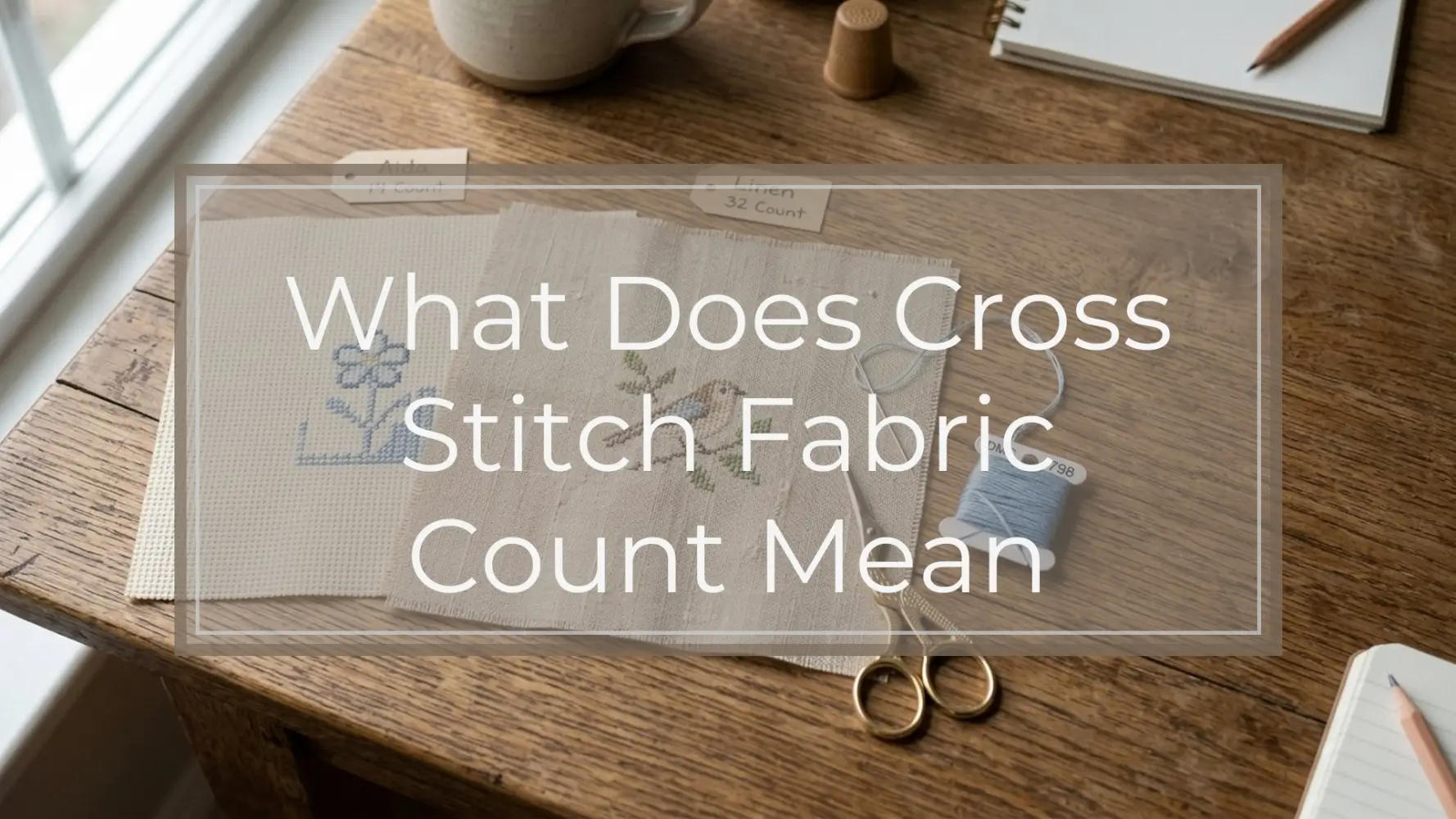
Cross stitch fabric count means how many fabric threads or stitchable squares there are per inch. A 14-count fabric has 14 stitches per inch when stitched over one square, while an 18-count fabric has 18 stitches per inch. Lower counts create larger stitches and a bigger finished design; higher counts create smaller stitches and a more detailed, compact design. Fabric count helps you choose the right fabric size, stitch size, needle, and thread coverage for your project.
In simple terms: the count tells you how tightly the fabric is woven for stitching. Once you understand count, pattern sizing, fabric shopping, and choosing between Aida, evenweave, and linen become much easier.
What Fabric Count Means in Cross Stitch
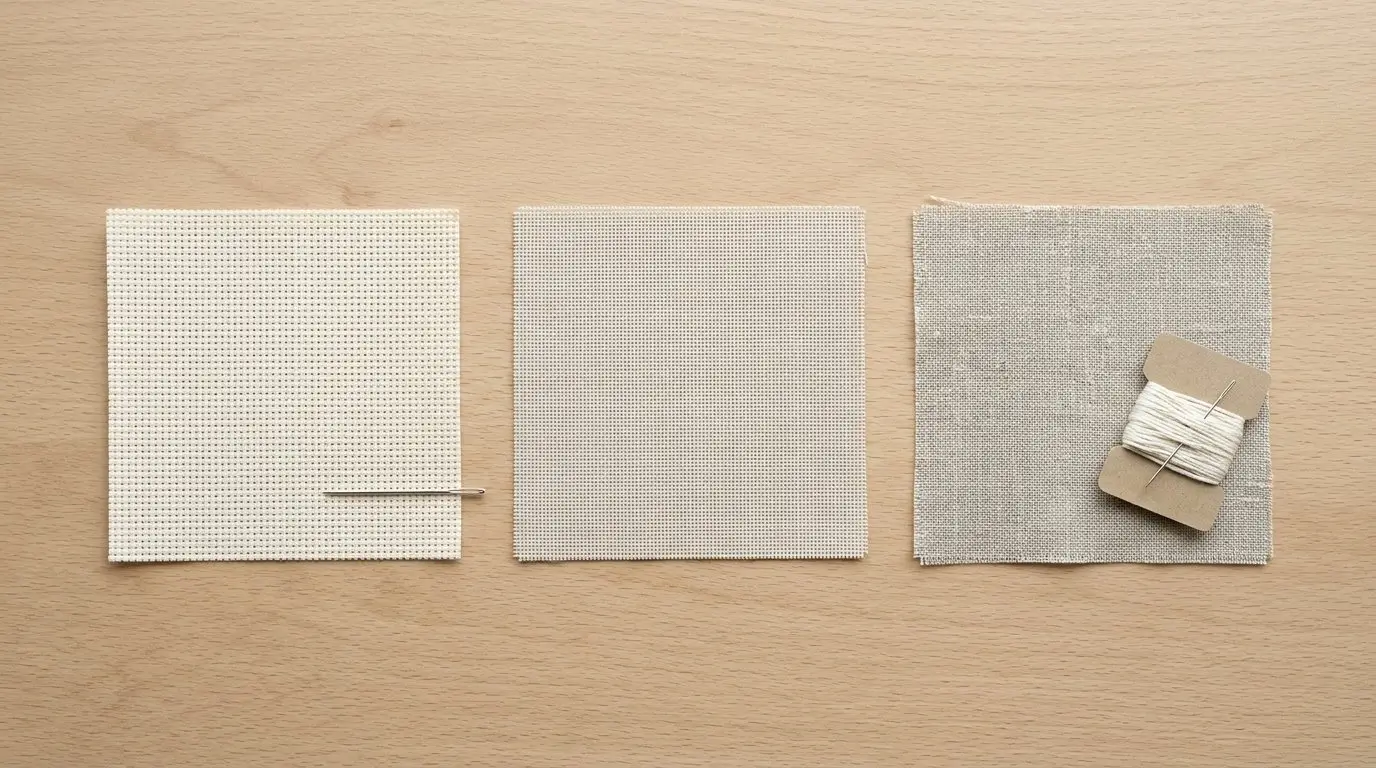
Fabric count is the number of stitchable units in one inch of fabric. On Aida, those units are the visible little squares. On evenweave and linen, they are fabric threads.
For example:
- 14-count Aida has 14 squares per inch.
- 16-count Aida has 16 squares per inch.
- 18-count Aida has 18 squares per inch.
The important part is that a higher fabric count does not mean the fabric itself is bigger. It means there are more stitches packed into each inch, so each individual stitch is smaller.
That affects three practical things:
- Finished design size — the same chart becomes smaller on higher-count fabric.
- Detail and appearance — higher counts can look finer and more compact.
- Stitching comfort — smaller stitches can be harder to see and may require better lighting or magnification.
A quick example: if a design is 70 stitches wide, it will be 5 inches wide on 14-count fabric because 70 ÷ 14 = 5. On 16-count fabric, the same design will be about 4.4 inches wide because 70 ÷ 16 = 4.375.
The chart did not change. Only the fabric count changed.
How Fabric Count Changes the Finished Size
Fabric count directly controls the stitched size of your project. The basic formula is:
Pattern stitch count ÷ fabric count = stitched size in inches
This works when you are stitching over one square or over one thread group that equals one stitch.
For example, say your cross stitch pattern is 84 stitches wide by 112 stitches high, and you want to stitch it on 14-count Aida.
- Width: 84 ÷ 14 = 6 inches
- Height: 112 ÷ 14 = 8 inches
So the stitched design area will be about 6 by 8 inches.
If you stitched that same 84 by 112 design on 16-count fabric:
- Width: 84 ÷ 16 = 5.25 inches
- Height: 112 ÷ 16 = 7 inches
The design becomes smaller, even though the chart has exactly the same number of stitches.
It is also important to separate stitched size from fabric cut size. The stitched size is only the area covered by the design. You usually need extra fabric around the design for framing, hooping, sewing, or finishing. Many stitchers add a generous border on all sides so the project is easier to handle and finish neatly.
Before cutting fabric, check:
- The pattern’s stitch count
- The fabric count you plan to use
- The intended finish, such as frame, hoop, ornament, or pillow
- Extra margin needed around the stitched area
Changing the fabric count is one of the easiest ways to make a design larger or smaller without changing the actual pattern.
Common Cross Stitch Fabric Counts Compared
Different fabric counts create different stitching experiences. None is automatically “best”; the right choice depends on your pattern, comfort, and the look you want.
| Fabric count | Stitch size | Finished design effect | Beginner friendliness | Common use |
|---|---|---|---|---|
| 11-count | Larger stitches | Bigger, more open design | Very beginner-friendly | Kids’ projects, quick designs, easy visibility |
| 14-count | Medium stitches | Standard, balanced size | Very common for beginners | General cross stitch, kits, samplers |
| 16-count | Slightly smaller stitches | Neater and more compact than 14-count | Beginner to intermediate | Detailed designs, smaller finished pieces |
| 18-count | Small stitches | Fine, compact finish | More challenging | Detailed patterns, ornaments, refined look |
| 25-count | Very small when stitched over one; medium when over two | Flexible depending on stitching method | Intermediate | Evenweave projects, full-coverage designs |
| 28-count | Usually medium when stitched over two | Similar size to 14-count Aida when over two | Intermediate | Evenweave and linen designs |
| 32-count | Smaller when stitched over two than 28-count | Fine, elegant finish | Intermediate to advanced | Linen samplers, detailed pieces |
A 14-count Aida fabric is often a comfortable starting point because the squares are easy to see and the finished size is not too tiny. However, some beginners may prefer 11-count for visibility, while others may enjoy 16-count if they like a slightly finer look.
With evenweave and linen, the count is often handled differently. A 28-count evenweave does not always mean 28 stitches per inch in the final project, because many stitchers work over two threads. In that case, 28-count fabric gives 14 stitches per inch.
Aida, Evenweave, and Linen: Does Count Work the Same Way?
Fabric count is related across all cross stitch fabrics, but it is not always interpreted in the same way.
Aida fabric
Aida is the most straightforward for many beginners. It has a clear grid of visible squares, and each square usually equals one cross stitch.
So if you are using 14-count Aida, you typically stitch one cross over one square. That gives you 14 stitches per inch.
Aida is popular because the holes are easy to find, the grid is clear, and counting stitches is relatively simple.
Evenweave and linen
Evenweave and linen are counted by threads per inch, not by obvious Aida-style squares. Instead of stitching into pre-formed squares, you count the fabric threads.
This is where “over one” and “over two” matter.
- Stitching over one means one cross stitch covers one fabric thread in each direction.
- Stitching over two means one cross stitch covers two fabric threads in each direction.
For example, if you use 28-count evenweave and stitch over two threads, your effective stitch count is:
28 ÷ 2 = 14 stitches per inch
That means a design stitched over two on 28-count evenweave will be similar in finished size to the same design stitched on 14-count Aida.
Likewise:
- 32-count fabric over two = 16 stitches per inch
- 36-count fabric over two = 18 stitches per inch
Linen works in a similar way, but natural linen can have slight irregularities in the weave. Some stitchers love the look and texture; others find Aida or evenweave easier for learning because the spacing is more predictable.
How to Choose the Right Fabric Count for a Project
The best fabric count is the one that suits the pattern, your comfort, and the finished look you want.
Start by checking the pattern instructions. Many patterns suggest:
- A fabric count
- A stitched design size
- A fabric cut size
- A number of floss strands
- Whether the design is stitched over one or over two
If you follow the suggested fabric count, your finished project should be close to the designer’s intended size. If you choose a different count, recalculate the stitched area before you cut fabric.
Comfort matters too. Consider:
- Eyesight: Higher counts have smaller holes and stitches.
- Lighting: Good lighting helps with 16-count, 18-count, linen, and evenweave.
- Needle size: Smaller fabric counts usually pair better with finer needles.
- Hand comfort: Some stitchers enjoy larger fabric holes; others prefer finer fabric.
- Project purpose: A wall piece, ornament, bookmark, and cushion may all benefit from different fabric choices.
Lower counts, such as 11-count or 14-count, are useful for beginners, children, quick projects, and designs you want to finish larger. The stitches are easier to see and usually faster to place.
Higher counts, such as 16-count, 18-count, or linen stitched over two, can work well for detailed designs, smaller finished pieces, ornaments, or a more refined appearance.
Thread coverage is another factor. The number of floss strands that looks good on 14-count fabric may look too bulky or too sparse on another count. Many patterns provide strand guidance, but personal preference also matters. If you are unsure, test a small stitched area before committing to the whole project.
Common Misconceptions About Fabric Count
Fabric count can be confusing at first, especially because “higher count” sounds like it should mean a larger project. In cross stitch, it is the opposite.
Misconception: Higher count means a bigger design
Higher count means more stitches fit into each inch. That makes each stitch smaller, so the finished design becomes smaller if the stitch count stays the same.
Misconception: You can swap any fabric count without consequences
You can often change fabric count, but it changes the finished size, stitch coverage, and difficulty level. A pattern designed for 14-count Aida will look and feel different on 18-count fabric or 28-count linen over two.
Misconception: Count only matters for advanced stitchers
Fabric count matters for every cross stitch project because it affects the final dimensions. Even a simple beginner pattern will change size if you change from 14-count to 11-count or 16-count fabric.
Misconception: All fabrics with the same count feel the same
Two 14-count fabrics can still feel different. Fiber content, weave, stiffness, dyeing, finishing, and brand style can all affect the fabric’s feel. Count tells you the stitch spacing, but it does not describe every quality of the fabric.
No single count is universally superior. The right fabric count depends on the design, the finish, and what feels comfortable to stitch.
FAQ
Is 14-count or 16-count cross stitch fabric better for beginners?
14-count Aida is often easier for beginners because the squares are larger and simpler to see. 16-count creates a slightly smaller, neater finish but can feel more detailed. Choose based on comfort, lighting, and how fine you want the finished design to look.
What does 28-count fabric mean if I stitch over two?
If you stitch over two on 28-count fabric, each cross stitch covers two fabric threads in each direction. That gives an effective count of 14 stitches per inch, so the finished size is similar to stitching the same pattern on 14-count Aida.
Does fabric count affect how many strands of floss I should use?
Yes. Lower-count fabrics often need more floss coverage because the stitches are larger. Higher-count fabrics may need fewer strands to avoid bulk. Always check the pattern first, then test a few stitches if you are changing fabric count.
How do I know what size fabric to buy for a cross stitch pattern?
Divide the pattern’s stitch width and height by your fabric count to get the stitched size. Then add extra fabric around all sides for framing, hooping, or finishing. If using evenweave or linen over two, use the effective stitch count, not just the thread count.