
Have you ever put down your embroidery or cross-stitch for a moment, only to lose your needle? We’ve all been there! A needle minder is a simple but clever magnetic tool that keeps your needles safe and easy to find while you’re working on a project.
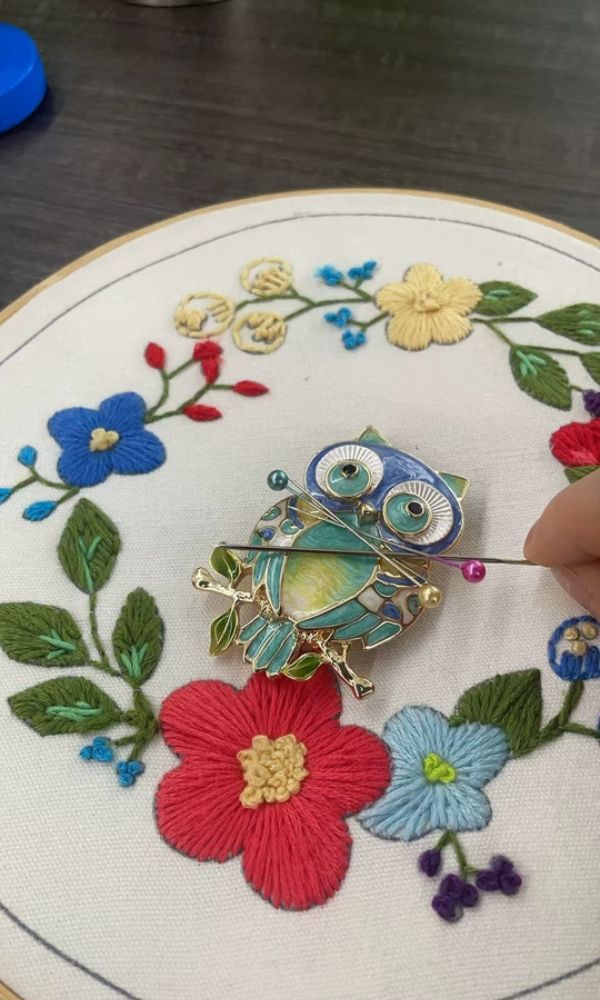
A needle minder consists of two magnets that sandwich your fabric, creating a secure place to store your needle when you’re not actively stitching. One decorative magnet sits on top of your fabric, while the second magnet attaches underneath, holding everything in place. This way, you can safely set aside your needle without worrying about it rolling away or getting lost in your couch cushions.
These handy tools come in countless fun designs, from cute animals to beautiful patterns, allowing you to add a personal touch to your crafting experience. You can easily move your needle minder around your project as you work, keeping your needle right where you need it and making your stitching time more enjoyable and stress-free.
What Are Needle Minders?
Needle minders are handy magnetic tools that help crafters keep track of their needles while working on projects. They’re simple yet clever devices that make stitching more organized and safer.
The Basic Function
A needle minder is a decorative magnetic tool that securely holds your needles when you’re not actively using them. It consists of two parts: a decorative front piece with a built-in magnet and a second magnet that goes behind your fabric. These two magnets sandwich your fabric between them, creating a strong hold without damaging your project.
When you need to set your needle down temporarily, instead of sticking it in the fabric or losing it in your lap, you simply place it on the needle minder. The magnet attracts the metal needle and holds it firmly in place.
This simple tool prevents lost needles, which can be a safety hazard. It also keeps your needles easily accessible so you can quickly resume your stitching without interruption.
Different Types of Needle Minders
Needle minders come in countless decorative designs to match your personality and crafting style. You can find them shaped like animals, flowers, food items, or featuring favorite characters. Many crafters collect different designs to suit their mood or project theme.
Some needle minders are made from hard enamel with vibrant colors, while others might be crafted from wood, metal, or resin. The key feature is that they all contain strong magnets to reliably hold your needles.
Magnetic strength varies between different needle minders. For heavier needles or multiple needles at once, look for ones with stronger magnets. Some crafters even make DIY needle minders using decorative buttons or pins attached to magnets.
Size is another variable – some are small and unobtrusive while others are larger statement pieces that add flair to your project.
The Importance of Using a Needle Minder
Needle minders are small but mighty tools that can make your stitching experience much more enjoyable. They help keep your workspace organized and your needles secure when you take a break.
Preventing Needle Loss
Have you ever put down your needle for just a moment, only to spend the next fifteen minutes searching for it? Needle minders solve this common frustration. They provide a designated spot to park your needle when you’re not actively stitching.
The magnetic surface grabs your needle and holds it firmly in place. This means no more needles disappearing into couch cushions or carpet fibers.
Think about how much time you’ve wasted looking for lost needles. A needle minder eliminates this problem entirely. You’ll always know exactly where your needle is, even if you need to step away from your project for hours or days.
For projects that take weeks or months to complete, a needle minder ensures you won’t lose special or expensive needles between stitching sessions.
Ensuring Safety
Loose needles create genuine safety hazards in your home. Sharp needles can poke fingers, get stepped on, or even be found by pets or children.
By using a needle minder, you dramatically reduce these risks. Your needle stays securely attached to the magnetic surface rather than lying hidden on furniture or floors.
This is especially important if you stitch in shared spaces or have children or pets around. A safely stored needle can prevent painful accidents and emergency trips to remove embedded needles.
Even when you’re alone, a needle minder prevents you from accidentally sitting on or stepping on your own needles. The small investment in a needle minder can save you from potential injury and provide peace of mind while you enjoy your craft.
How Needle Minders Work
Needle minders use a simple but clever magnetic system to keep your needles safe and accessible while you’re stitching. They make your crafting experience more organized and prevent those frustrating needle losses!
Magnetic Mechanisms
Needle minders consist of two main parts: a decorative front piece with a strong magnet attached to its back, and a second separate magnet. This two-magnet system is what makes needle minders so effective and easy to use.
The decorative front piece comes in many materials like wood, clay, or metal. You can find them in countless designs to match your personality or project theme. The magnet in this piece is powerful enough to hold your needles securely.
When you place a needle on the decorative front, the magnet grabs it right away. The magnetism is strong enough to hold several needles at once, which is helpful when you’re working with multiple needle sizes or thread colors.
Attachment to Fabric
The clever part about needle minders is how they attach to your fabric without damaging it. You simply place the decorative front piece with its magnet on top of your fabric.
Then you position the second magnet underneath your fabric, directly below the top magnet. The two magnets attract each other through the fabric, creating a secure hold without pins or clips that might damage your work.
This sandwich-like arrangement keeps the needle minder firmly in place while you stitch. You can easily reposition it anywhere on your project as you work on different sections. The magnets are strong enough to stay put but not so strong that they’re difficult to move.
Your fabric stays safe between the magnets, with no holes or marks left behind. This makes needle minders perfect for delicate fabrics and valuable projects.
Choosing the Right Needle Minder
Finding the perfect needle minder is about balancing both function and style. The strength of the magnet and how well it works with your specific project size are two key factors to consider.
Strength of the Magnet
The magnet is the heart of your needle minder. You’ll want to look for needle minders with strong magnets that can securely hold your needles without letting them slip off.
Some needle minders come with single magnets, while others feature dual magnets for extra holding power. If you work with heavier needles or in situations where your project moves around a lot (like stitching on the go), strong magnets are essential.
Test your needle minder’s strength by seeing if it can hold your needle through your fabric. A good needle minder should keep your needle in place even when you tilt your fabric at various angles.
When shopping, look for terms like “neodymium magnets” or “rare earth magnets” – these are typically stronger than standard magnets.
Compatibility with Project Size
The size of your needle minder should match your project needs. For large projects, you might want a slightly bigger needle minder that’s easy to spot among your work.
For small, intricate projects, a compact needle minder won’t get in your way. If you carry your projects in a project bag, consider whether your needle minder is flat enough not to create bulges or damage your work.
Some stitchers keep different sized needle minders for various projects:
- Small (under 1 inch) for delicate work
- Medium (1-2 inches) for everyday projects
- Large (over 2 inches) for visibility on big projects
Your needle minder should also be lightweight enough that it doesn’t pull on your fabric and cause distortion in your stitching area.
Creative Uses for Needle Minders
Needle minders aren’t just for keeping track of your needles during cross stitch projects. These handy magnetic tools can serve multiple purposes in your crafting life and beyond.
Beyond Stitching
Did you know your needle minders can be useful outside of your embroidery hoop? Try using them as fancy refrigerator magnets to hold up notes or shopping lists. The decorative front pieces add a personal touch to your kitchen.
You can also use needle minders to organize small metal items in your crafting space. Things like pins, tiny scissors, or metal thimbles will stick right to them!
When traveling with your projects, needle minders can secure fabric edges together without damaging delicate materials. This keeps everything neat in your project bag.
Some crafters even use them as makeshift closures for lightweight project bags or as bookmarks for pattern books. The possibilities are only limited by your imagination!
Decorative Purposes
Your needle minders can double as wearable accessories! Attach one to your shirt as a magnetic brooch or pin. Just be careful with delicate fabrics that might get damaged.
Display your collection on a magnetic board in your craft room. This creates an eye-catching wall art piece while keeping your favorites easily accessible.
Use them as decorative elements on gift packages instead of bows. The recipient gets two gifts in one – pretty packaging and a useful crafting tool!
Some crafters attach needle minders to picture frames or mirrors for a personalized touch. You can change them out seasonally or based on your mood.
If you have a metal lamp base, needle minders can adorn it for a custom look that reflects your personality and crafting style.
Attaching Needle Minders to Different Materials
Needle minders can be attached to various surfaces, but the method differs depending on what you’re working with. The magnetic backing works differently on fabrics versus harder surfaces.
Fabrics and Textiles
When attaching your needle minder to fabric, place the decorative front piece on top of your fabric. Then position the magnetic backing piece directly behind the fabric. The magnets will attract each other through the fabric, holding the needle minder in place.
For thin fabrics like cotton or linen, the magnetic connection works perfectly. With thicker fabrics like denim or canvas, you might need stronger magnets.
Tips for fabric attachment:
- Position your needle minder near your working area but not in the way
- Move it as needed while you stitch
- For slippery fabrics, use a stronger magnet
- Avoid placing it where you’ll be actively stitching
The magnet shouldn’t damage most fabrics, but be careful with delicate materials like silk.
Other Surfaces
Your needle minder isn’t limited to fabric projects! You can attach it to many different surfaces.
For wooden frames, the magnetic backing may still work if the wood is thin enough. If not, you can use a small adhesive dot to temporarily stick the backing magnet to the frame.
Metal surfaces like magnetic whiteboards or refrigerators make perfect homes for needle minders – simply place the decorative front piece directly on the metal surface.
For plastic hoops, place the backing magnet inside the hoop and the decorative piece outside. This works great for keeping your needle safe during project breaks!
Remember that needle minders work best on fairly flat surfaces where both magnets can align properly.
Maintaining Your Needle Minder
Taking good care of your needle minder helps it last longer and work better. Regular maintenance keeps the magnet strong and the decorative front looking nice.
Cleaning Procedures
Your needle minder needs occasional cleaning to stay in top shape. Dust and fabric fibers can build up on the magnet over time, making it less effective.
For basic cleaning, gently wipe both sides of your needle minder with a soft, dry cloth. This removes surface dust and loose threads.
If your needle minder has gotten dirty, you can use a slightly damp cloth with mild soap. Be very careful not to get too much water near the magnet, as moisture can cause rusting.
For stubborn dirt, use a cotton swab dipped in rubbing alcohol, especially around the edges where dirt collects. Let the needle minder dry completely before using it again.
Avoiding Damage
Strong magnets in needle minders can be fragile despite their power. Dropping your needle minder repeatedly can weaken the magnet or crack the decorative front.
Store your needle minder away from other magnetic items when not in use. Keeping it attached to your project or in a small container works well.
Heat can damage both the magnet and any adhesive holding your needle minder together. Don’t leave it in direct sunlight or hot cars.
Avoid placing your needle minder near electronics or credit cards. The strong magnet can interfere with devices and erase magnetic strips.
If you notice the magnet becoming weaker, it might be time to replace the magnetic backing rather than the entire needle minder.
DIY Needle Minder Ideas
Making your own needle minders is both fun and practical. With just a few simple supplies, you can create custom minders that match your style and keep your needles safe.
Crafting Your Minder
To make a basic needle minder, you’ll need three main supplies: a decorative item, a strong magnet, and adhesive. Enamel pins work wonderfully as the decorative front piece. Simply remove the pin backing using pliers.
For magnets, neodymium ones work best due to their strength. You’ll need two magnets – one to attach to your decorative piece and another to place behind your fabric.
Apply a strong adhesive like E6000 or a hot glue gun to attach the magnet to the back of your decorative piece. Let it dry completely before using. This system creates a sandwich with your fabric in the middle – the decorated magnet on top and the second magnet underneath.
Personalizing Your Design
The fun part of DIY needle minders is choosing designs that reflect your personality or project themes. Repurpose items you already own like buttons, small toys, charms, or jewelry pieces.
Craft stores offer miniature resin figures, wooden shapes, and polymer clay that make excellent minder bases. You can even create themed sets to match different projects.
For a truly personal touch, try painting wooden discs or creating custom designs with polymer clay. Add sparkle with rhinestones or tiny beads for extra flair.
Button collectors can showcase special buttons by turning them into functional needle minders. Old earrings without pairs find new purpose as minders too!
Remember, the decorative piece should be lightweight so the magnet can hold it securely to your fabric without slipping.
Troubleshooting Common Needle Minder Issues
While needle minders are simple tools, you might encounter a few issues when using them. These problems usually involve magnetic strength or managing multiple needles efficiently.
Weak Magnetic Connection
If your needle minder keeps dropping needles, the magnet might be too weak. This happens with older needle minders or lower-quality ones that use weaker magnets.
Try cleaning both sides of your needle minder. Sometimes dust or fabric fibers can get between the magnets and reduce their effectiveness.
You can also test the strength by holding the decorative front piece and seeing how strongly it attracts to the back magnet. If it barely connects, it’s time for a replacement.
Consider upgrading to a needle minder with stronger neodymium magnets. These powerful magnets ensure your needles stay put even if your project gets jostled around.
Handling Multiple Needles
When working with different needle sizes or thread colors, organization becomes tricky. Your needle minder can only hold so many needles before they cluster together.
Try using a larger needle minder with a wider magnetic surface. Some crafters use multiple needle minders – one for each needle type or thread color.
You can create a simple system by positioning needles in different patterns on your minder. Perhaps place threaded needles on top and empty ones on the bottom.
For complex projects, consider a needle book with felt pages in addition to your minder. This gives you more storage options while keeping your active needle handy on the minder.
Needle Minders and Different Stitching Techniques
Needle minders are super helpful no matter what kind of stitching project you’re working on. They keep your needles safe and within reach, making your stitching time more enjoyable and organized.
Cross Stitch and Embroidery
When you’re working on cross stitch or embroidery, needle minders are absolute game-changers! Place your magnetic needle minder directly on your fabric while you stitch. This gives you a safe spot to rest your needle when you need to pause, change threads, or answer the phone.
For projects that need frequent thread changes, like detailed embroidery, a needle minder prevents you from sticking needles in your clothing or losing them in cushions. Many stitchers actually use multiple needle minders on larger projects – one for the working needle and others for specialty needles.
The flat surface of a needle minder also works great for holding small scissors or threaders. When working with hoops or frames, position your needle minder near the edge of your work for easy access without covering your pattern.
English Paper Piecing
For English Paper Piecing (EPP), needle minders serve a special purpose in your sewing toolkit. Since EPP involves a lot of hand sewing and basting of fabric pieces, having a reliable spot for your needle is extra important.
As you move between different fabric pieces, you can quickly place your needle on the minder instead of searching for a pincushion. Some quilters attach their needle minders to small project bags or EPP kits for portable sewing.
When working with multiple needle types (like a thinner needle for basting and a sturdier one for joining pieces), use a needle minder to keep them organized but accessible. The magnetic surface also helps prevent those tiny quilting needles from disappearing into carpets or cushions.
Try positioning your needle minder on a small fabric weight near your work area during EPP sessions!