
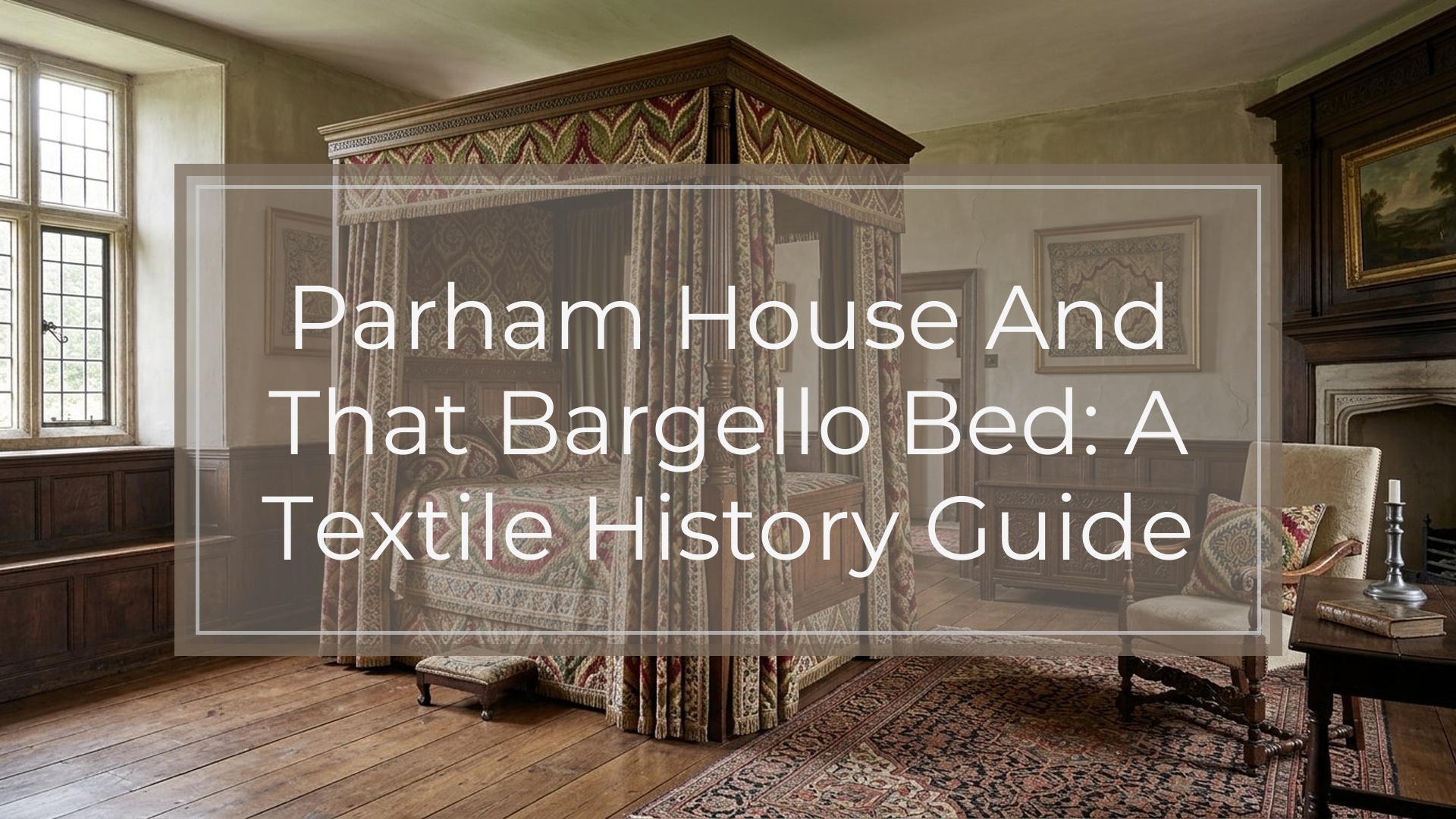
The Bargello bed at Parham House is one of the most memorable historic examples of flame stitch, or Bargello-style, needlework used on a grand furnishing scale. Rather than appearing as a small sampler or cushion, the pattern covers a bed hanging with bold, rhythmic waves of color. That scale is part of its power: it shows Bargello as an architectural textile, not just a decorative stitch.
For modern stitchers, the bed matters because it makes the core logic of Bargello easy to see. Repeated upright stitches, stepped in height and color, create movement. The lesson is practical as well as historical: strong color planning, consistent stitch length, and repeated structure can turn a simple stitch into a dramatic textile.
Quick Answer
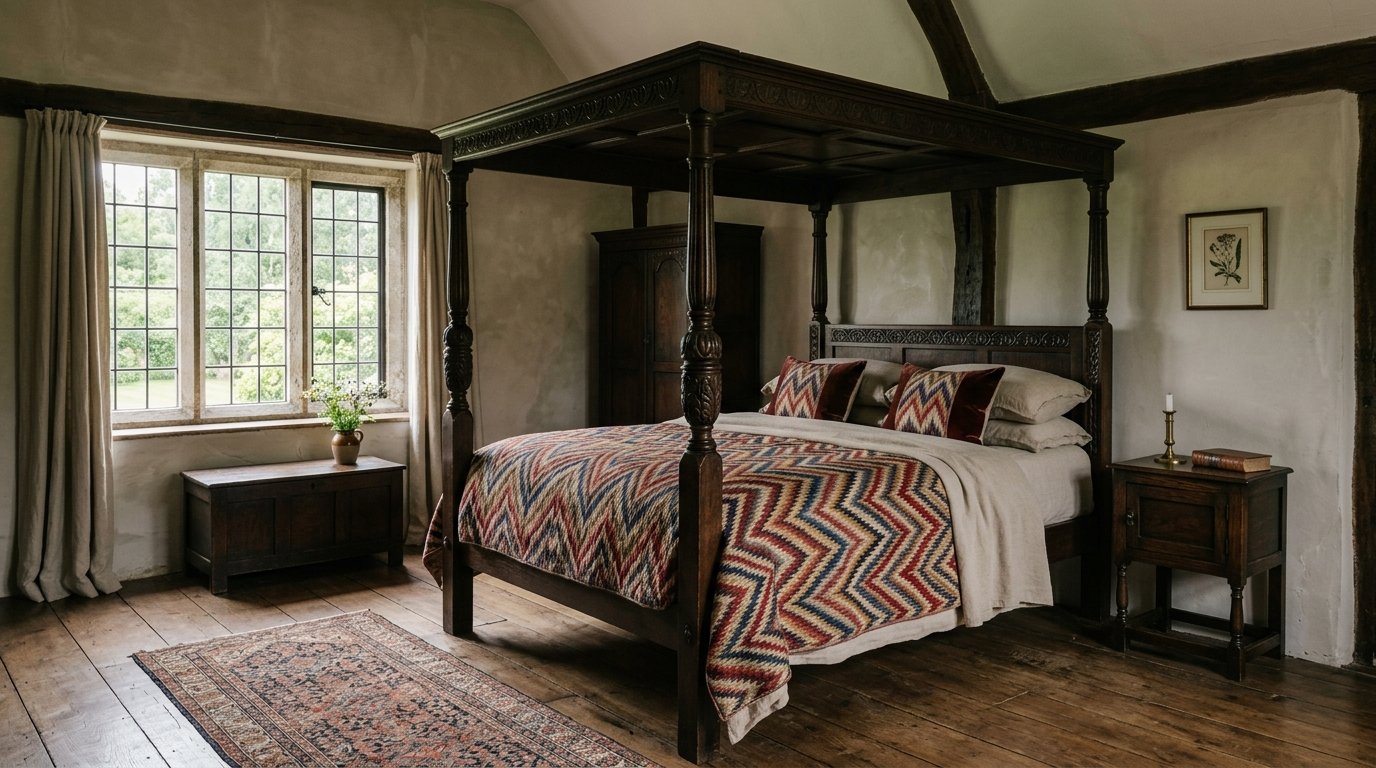
The main takeaway is this: the Bargello bed at Parham House is important because it shows how a relatively simple counted stitch technique can become a large, luxurious furnishing textile when scale, rhythm, and color are handled well.
Parham House, in West Sussex, England, is known for its historic interiors and textile collections. The famous Bargello bed is often discussed by needlework enthusiasts because it connects several things at once: domestic furnishing, historic embroidery, flame stitch design, and the long life of needlework as both practical decoration and status object.
Bargello is usually worked as straight vertical stitches over a counted ground, often canvas. The stitches are arranged in stepped patterns, so the surface forms peaks, waves, flames, or zigzags. On a small object, such as a pincushion, this creates a lively geometric pattern. On a bed hanging, the same principle becomes much more dramatic. The eye reads the repeated points almost like woven movement.
The Parham example matters because it reminds modern stitchers that Bargello is not only about filling a shape. It is about controlled repetition. The design succeeds when stitch direction, spacing, and color changes all serve the same visual rhythm.
How to Think About This Topic
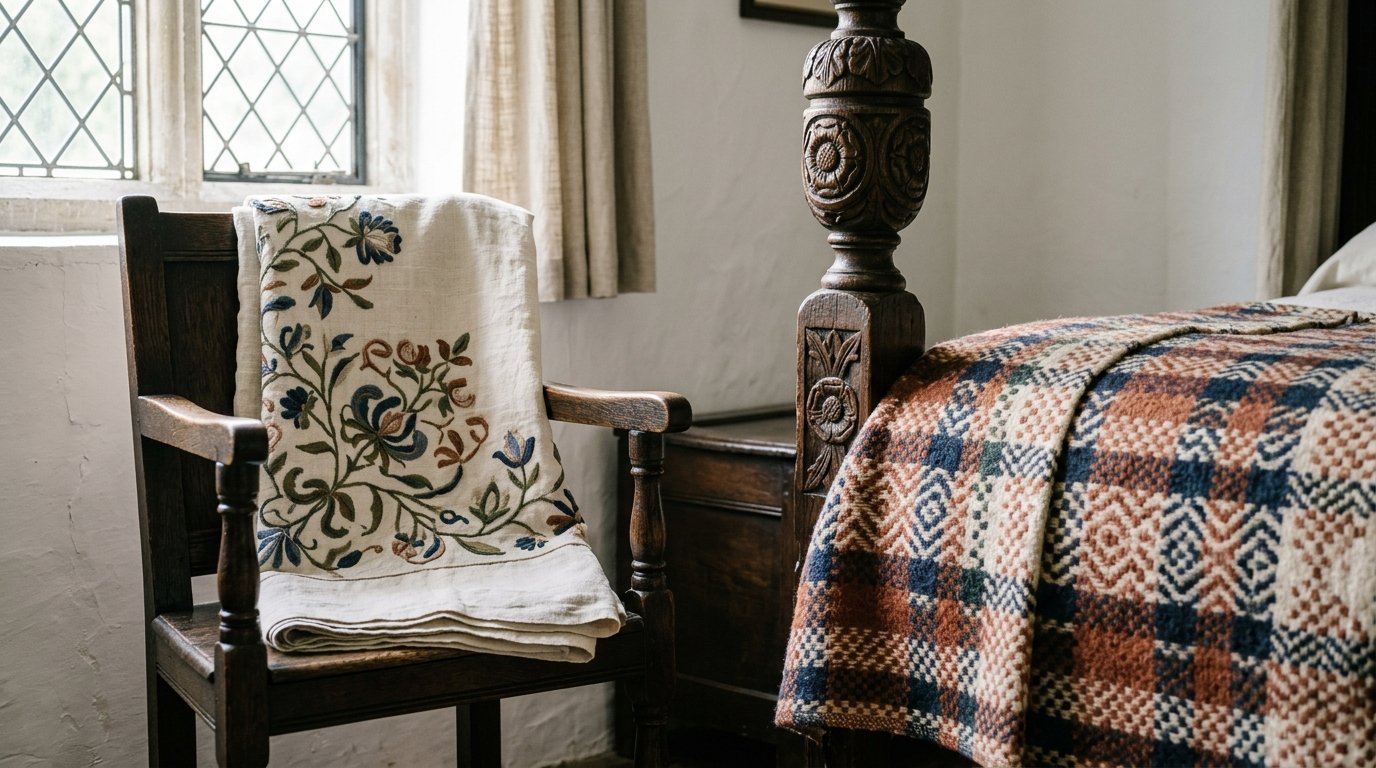
A useful way to think about Parham House and that Bargello bed is to separate the subject into three layers: the object, the technique, and the design lesson.
First, the object is a historic furnishing. A bed in a great house was not just a place to sleep. It could be a major display piece, dressed with hangings, covers, curtains, and valances. Textiles helped show taste, wealth, and household skill. A boldly stitched bed would have shaped the whole room, much as wallpaper or upholstery does today. This is why the Parham bed feels so different from a small Bargello project. It belongs to the world of interiors.
Second, the technique is built from repetition. Bargello often uses upright satin-like stitches worked over a set number of canvas threads. The stitch itself is not complicated, but the pattern depends on counting accurately. If one step is misplaced, the flame or wave can break. This combination of simple motion and strict structure is one reason Bargello remains appealing. It feels meditative, but it still rewards attention.
Third, the design lesson is color movement. Bargello patterns rely on sequences: dark to light, warm to cool, bright to muted, or several shades of one hue. The Parham bed is often admired because it demonstrates the effect of color bands over a large area. A small change repeated many times becomes a strong visual current. That is the heart of the keyword phrase “Parham House and that Bargello bed”: people are not only asking what the object is, but why it stays in the imagination.
For stitchers, the mental model is simple: Bargello is a counted pattern that behaves like a textile wave. The stitches are the units, the stepped outline is the rhythm, and the color sequence is the energy. When those three parts agree, the result can be striking whether the project is a bookmark, cushion, chair seat, or bed hanging.
This also explains why historic Bargello is so useful to study. You do not need to copy an old furnishing exactly. Instead, you can observe how large patterns manage contrast, how repeats are spaced, and how a limited stitch vocabulary can still produce richness.
Practical Guidance
Modern stitchers can learn several practical lessons from the Bargello bed without attempting anything as large as a historic bed hanging.
Start with scale. A flame stitch that looks busy on a pincushion may look balanced on a cushion. A pattern that feels bold on a cushion may become magnificent on a wall hanging or upholstered panel. Before stitching, ask where the finished piece will live and how far away it will usually be viewed. Large rooms can handle larger repeats and stronger contrast. Small accessories often need tighter color control.
Next, choose a clear color path. Many successful Bargello designs use families of related shades: several blues, several reds, or a warm range moving from gold to orange to rust. High contrast can be effective, but it should be intentional. If every color fights for attention, the flame shape becomes harder to read. The Parham bed’s lesson is not “use many colors”; it is “make the colors move together.”
Also pay attention to stitch height and stepping. Bargello patterns often rise and fall by regular increments. For example, a stitch might be worked over four threads, then the next stitch begins two threads higher, and so on. That predictable climb creates the flame. Beginners should mark the first repeat carefully, then check each new repeat against it. Accuracy at the start saves a lot of unpicking later.
Here is a practical way to translate the historic lesson into project choices:
| If you want to make… | Choose this Bargello approach | Why it works |
|---|---|---|
| A pincushion or ornament | Small repeat, limited palette | Keeps the pattern readable in a tiny space |
| A cushion front | Medium flame or wave pattern | Gives enough room for color movement |
| A chair seat | Durable canvas and wool | Suits furnishing use and repeated handling |
| A wall hanging | Larger repeat, stronger contrast | Allows the design to be seen from a distance |
| A bed runner or panel | Long horizontal rhythm | Echoes the furnishing scale of historic examples |
For materials, needlepoint canvas and tapestry wool are traditional choices for robust furnishing work. Cotton floss can work for smaller decorative pieces, though it produces a different surface. The key is to match thread weight to canvas size so the ground is covered evenly without becoming bulky.
If you are new to Bargello, begin with a small rectangle rather than a shaped design. Work one full repeat in pencil on graph paper or follow a reliable chart. Use three to five colors before attempting a complex palette. This teaches the essential discipline: count, stitch, step, repeat.
Preservation is another lesson. Historic pieces survive when they are protected from light, dirt, strain, and rough handling. For your own work, that means using good materials, finishing edges properly, and thinking about use. A decorative cushion can be softer and more delicate. A chair seat needs stronger thread, secure stitching, and sensible placement away from constant sunlight.
The Parham bed is inspiring because it proves that Bargello does not need complicated stitches to feel grand. Its strength comes from disciplined design decisions repeated with confidence.
FAQ
Is Bargello the Same as Flame Stitch?
The terms are often used closely together. Flame stitch usually describes the pointed, rising-and-falling pattern that looks like flames. Bargello is the broader needlework style associated with these counted upright stitches and stepped color patterns. In everyday craft use, many stitchers use the names interchangeably.
Can Beginners Try Bargello Embroidery?
Yes. Bargello is beginner-friendly if the first project is small and clearly charted. The stitch motion is simple, but accurate counting matters. A bookmark, coaster, or small cushion panel is a better starting point than a large furnishing project.
What Materials Are Usually Used for Bargello?
Traditional Bargello is often worked on needlepoint canvas with wool thread, especially for cushions, chair seats, and other furnishings. Smaller modern projects may use cotton floss or tapestry yarn. The important choice is matching thread thickness to the canvas so the coverage looks smooth.
Do I Need to Visit Parham House to Learn from the Bargello Bed?
No. Seeing the bed in person would be valuable, but the main lessons can be studied from images and descriptions: bold scale, repeated stepped stitches, and controlled color movement. Modern stitchers can apply those principles to much smaller projects.