
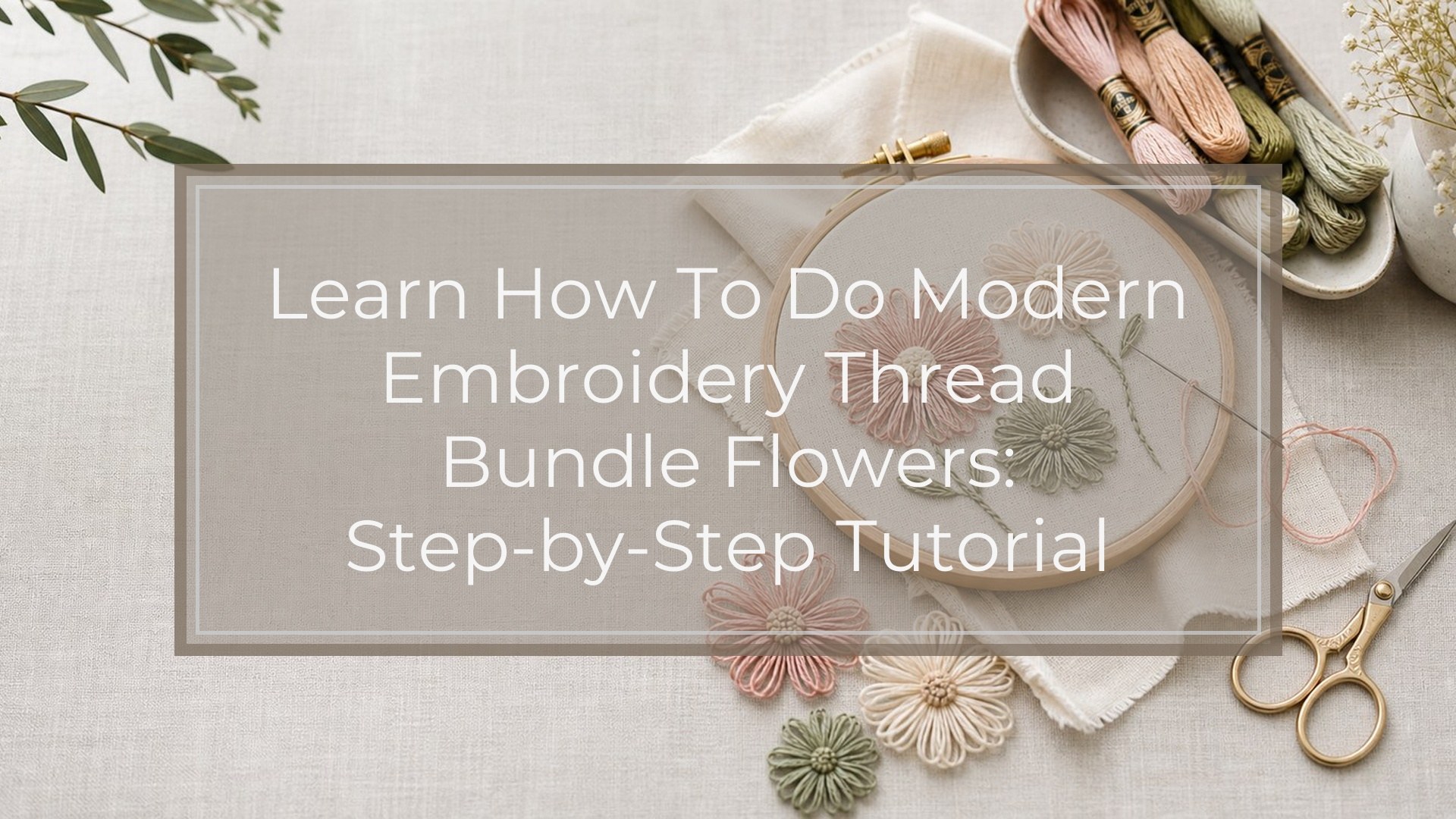
Thread bundle flowers are stitched by grouping several strands of embroidery floss together, laying them on the fabric surface, and anchoring them into petal shapes. Instead of building a flower with many tiny stitches, you create bold, soft petals from small bundles of thread. The result feels modern: slightly raised, textured, and graphic, with room for loose shapes and playful color.
To learn how to do modern embroidery thread bundle flowers, focus on three things: the size of each bundle, the angle of each petal, and how gently you secure the thread. Once you understand that the bundle sits mostly on top of the fabric, the technique becomes simple and forgiving.
What Are Modern Embroidery Thread Bundle Flowers?
Modern embroidery thread bundle flowers are dimensional flowers made from short grouped lengths of floss. Each petal is a small bundle that starts near the flower center, extends outward, then is couched or anchored back into place.
Think of each petal as a soft loop or laid thread shape rather than a flat satin stitch. The thread should look full, slightly rounded, and intentional. These flowers suit contemporary hoops because they create texture quickly and do not need perfect realism. They can look like abstract daisies, loose wildflowers, tiny pom-poms, or layered blossoms depending on strand count and placement.
Materials and Setup
You only need basic embroidery supplies, but each choice affects the finished flower:
- Embroidery floss: Six-strand cotton floss works well. Use all six strands for bold petals, or three to four strands for smaller flowers.
- Needle: Choose a sharp embroidery needle with an eye large enough for your strand count.
- Fabric: Medium-weight cotton, linen, or cotton-linen blend gives good support.
- Hoop: Keep the fabric drum-tight so the bundles sit neatly on the surface.
- Scissors: Sharp tips help trim thread ends cleanly.
- Marking tool: A water-soluble pen or light pencil dot helps place the center and petal tips.
- Optional center thread: French knots, seed stitches, or a small satin stitch center can finish the flower.
Avoid very loose-weave fabric for your first try, because bundled petals can pull the weave open.
Plan the Flower Before You Stitch
Before threading the needle, decide how large and full you want the flower to be. Mark a small center dot, then lightly mark where each petal should end. Most simple flowers use five to eight petals.
Use fewer strands for tiny flowers and more strands for bold modern blooms. Petal length matters too: short bundles look compact and puffy, while longer bundles look relaxed and airy.
| Flower style | Strand count | Petal length | Best use |
|---|---|---|---|
| — | —: | —: | — |
| Tiny accent flower | 3 strands | 1/8–1/4 in | Sprays, borders, small hoops |
| Soft daisy shape | 4–6 strands | 1/4–1/2 in | Main floral clusters |
| Bold abstract bloom | 6+ strands or doubled floss | 1/2–3/4 in | Statement petals |
For a modern look, leave a little unevenness. Petals do not all need to match exactly.
Step-by-step: How to Stitch Thread Bundle Flowers
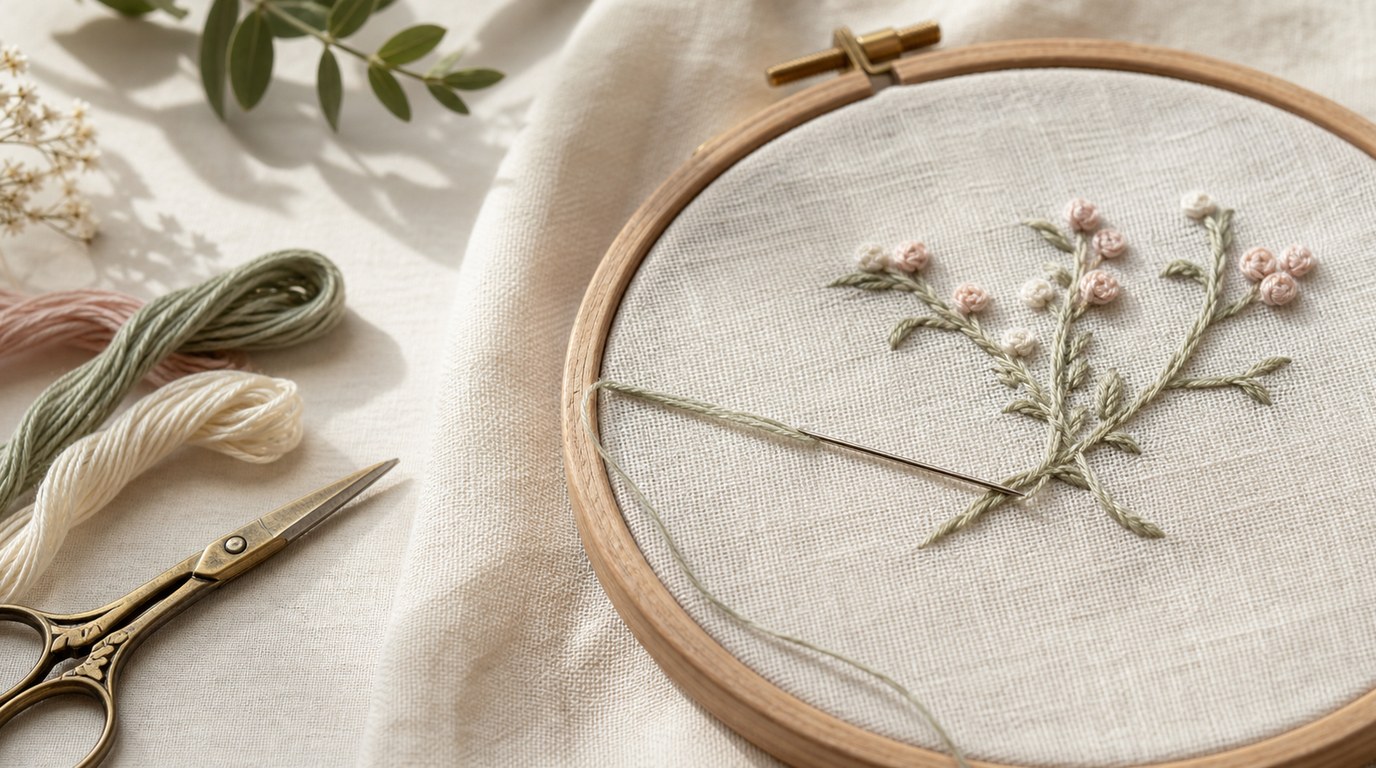
- Hoop your fabric tightly. Smooth, firm fabric helps the thread bundle keep its shape instead of sinking or twisting.
- Mark the flower. Place one dot for the center. Add small guide dots around it for petal tips, like spokes on a wheel.
- Cut your floss. Use a manageable length, about 12–16 inches. Separate and recombine the strands if needed so they lie smoothly together.
- Thread the needle and knot the end. For a neater back, use a small knot or start with a few tiny anchoring stitches where the center will be covered.
- Bring the needle up near the center. This is the base of your first petal.
- Lay the bundle outward. Hold the floss as a group and guide it toward the petal-tip mark. Do not pull hard. The bundle should rest on top of the fabric.
- Anchor the petal tip. Take the needle down just beyond the tip mark, catching the bundle so it forms a soft laid petal. Keep the tension gentle; pulling too tightly will flatten the petal.
- Return to the center. Bring the needle up again close to the first starting point, ready for the next petal.
- Repeat around the flower. Work one petal at a time, rotating around the center. Angle each bundle outward like a ray. If the petals overlap slightly, that is fine and can add fullness.
- Secure loose areas if needed. For longer petals, add a tiny couching stitch across the middle of the bundle using matching thread. This keeps the petal from shifting without making it look pinned down.
- Stitch the center. Cover the petal bases with French knots, small straight stitches, seed stitches, or a compact satin stitch circle.
- Check the shape. If one petal looks too loose, add a small anchoring stitch. If one looks too tight, gently lift the bundle with the needle tip before finishing the back.
End the thread by weaving it under nearby stitches on the back. Avoid bulky knots directly behind the flower center.
Two Easy Variations for Modern Floral Designs
Layered bundle flower: Stitch one round of longer petals first, then add a second round of shorter petals between them. Use a slightly lighter or darker shade for the top layer. This creates a full flower without complicated stitching.
Loose wildflower spray: Make several small bundle flowers along a curved stem. Use three to five petals per flower and vary the angles. Add simple straight-stitch leaves or tiny detached chain leaves. Keep the flowers irregular so the spray feels natural and modern.
Both variations use the same basic method: lay the bundle, anchor the tip, return to the center, and cover the bases.
Tips for Neat, Dimensional Petals
Keep your tension light. Thread bundle flowers look best when the floss sits proudly on the fabric, not when it is pulled flat.
Comb the strands lightly with your fingers before stitching so the bundle lies smooth. If the floss twists, let the needle dangle for a moment to unwind. For rounded petals, anchor just past the guide dot so the thread has room to puff slightly.
Use the same entry area near the center, but do not pierce the exact same hole every time. Reusing one hole can weaken the fabric. Finally, cover the center generously; a strong center makes the whole flower look finished.
Common Problems and How to Fix Them
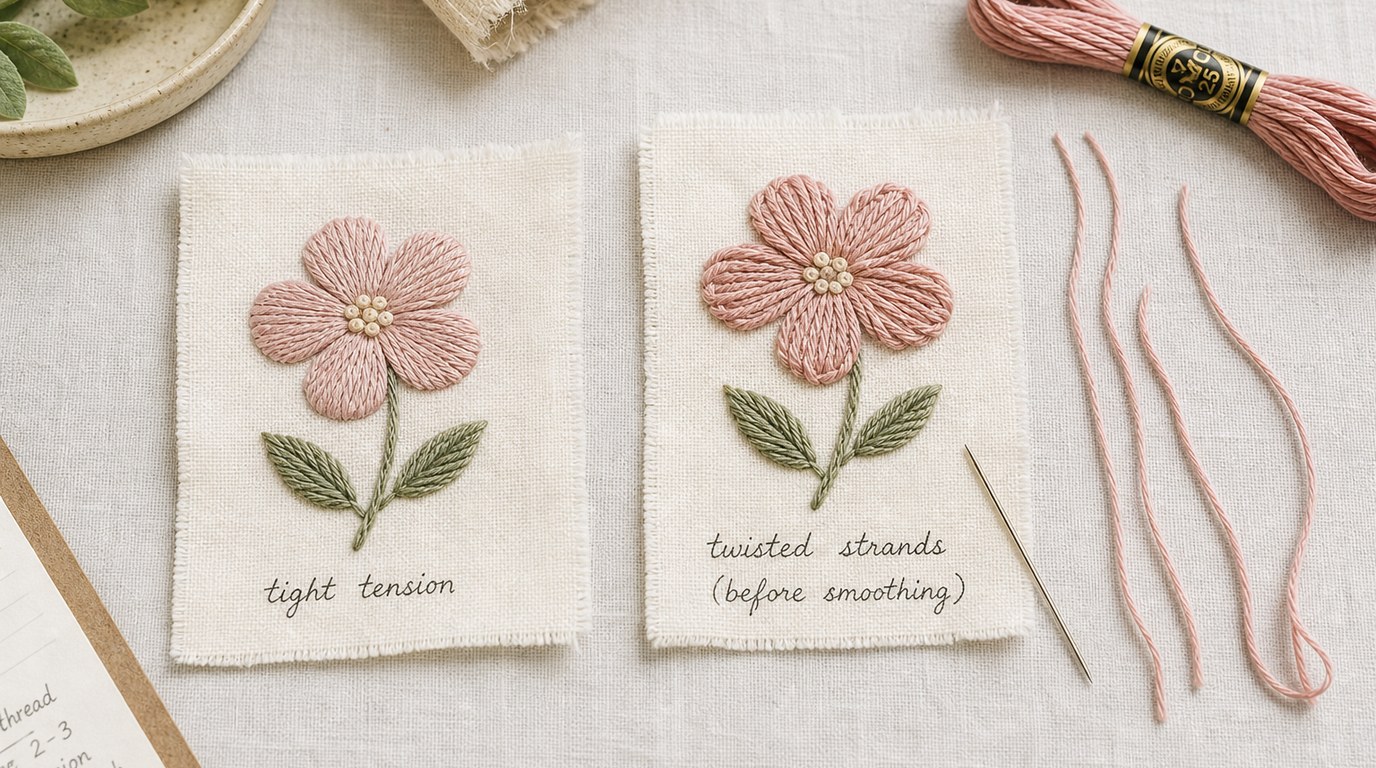
Petals look flat: You are pulling too tightly. Loosen your tension and let the bundle rest on the fabric surface.
Petals twist: Separate the strands, smooth them, and recombine before stitching. Let the needle untwist often.
Flower looks uneven: Add one or two small filler petals, or make the center slightly larger to balance the shape.
Fabric puckers: Your hoop may be loose, or your anchoring stitches are too tight. Re-hoop the fabric and stitch with a lighter hand.
Petals move around: Add tiny couching stitches in matching thread, especially on longer petals.
Where to Use Thread Bundle Flowers
Thread bundle flowers work well on hoop art, monograms, linen napkins, denim pockets, tote bags, and decorative patches. They are especially useful when you want texture without filling a large area with dense stitching.
Use them as focal flowers, scattered accents, or clustered buds around stems. For wearable items, keep petals shorter and add extra couching so the bundles stay secure.
FAQ
What Should a Beginner Know First About Learn How to Do Modern Embroidery Thread Bundle Flowers?
Start by understanding that the thread bundle sits mostly on top of the fabric. You are laying and anchoring grouped strands, not filling a shape with tight stitches. Gentle tension, a firm hoop, and a covered center are the keys to a clean first flower.
What Matters Most When Evaluating Learn How to Do Modern Embroidery Thread Bundle Flowers?
Look at petal shape, tension, and security. The petals should look soft but intentional, with no severe twisting or puckering. The center should hide the thread bases, and each bundle should be anchored well enough that it does not slide out of place.
What Mistakes Should Readers Avoid with Learn How to Do Modern Embroidery Thread Bundle Flowers?
Avoid pulling the floss too tight, using fabric that is too loose, or making very long petals without couching. Also avoid forcing every petal to be identical. Slight variation often makes modern floral embroidery look fresher and more natural.
What Is the Next Logical Step After Learning About Learn How to Do Modern Embroidery Thread Bundle Flowers?
Practice a small sampler with three flower sizes: tiny, medium, and bold. Then combine thread bundle flowers with simple stems, leaves, French knots, and seed stitches. This helps you build complete modern floral designs while reinforcing the same bundle technique.