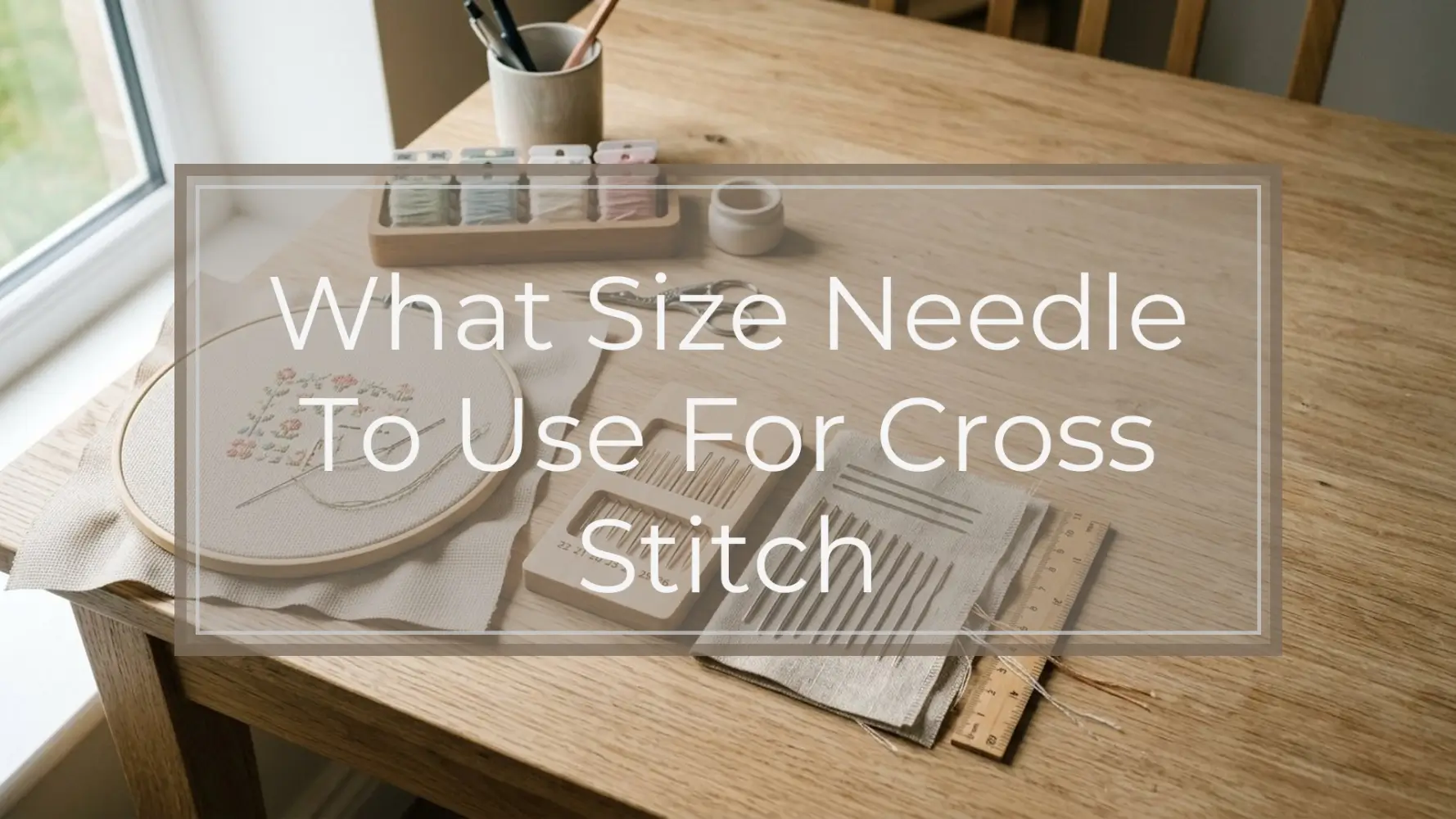
Quick answer: For most cross stitch, use a blunt tapestry needle. Match the needle size to your fabric count: size 24 for 14-count Aida, size 26 for 16-count Aida or 28-count evenweave over two threads, and size 28 for 18-count Aida or 32-count evenweave over two threads. If the needle drags, splits stitches, or enlarges the fabric holes, go smaller. If it is hard to thread or feels flimsy, go one size larger.
Cross stitch needles are chosen by how well they pass through the existing holes in your fabric. The right needle should guide your floss through smoothly without forcing the hole open or shredding the thread. Use the chart below as your starting point, then test a few stitches before committing to a full project.
Quick Needle Size Chart for Cross Stitch
Cross stitch is usually worked with a blunt tapestry needle, not a sharp embroidery or sewing needle. The blunt tip helps the needle slip through the fabric holes instead of piercing the fabric threads.
One important detail: tapestry needle numbers work in reverse. A larger number means a smaller needle. For example, a size 28 tapestry needle is finer than a size 24.
| Fabric Type/Count | Common Needle Size | Best For | Notes |
|---|---|---|---|
| 11-count Aida | Size 22 | Larger holes, beginner-friendly projects | Roomier needle for larger fabric holes |
| 14-count Aida | Size 24 | Most standard cross stitch kits and patterns | A common all-purpose choice |
| 16-count Aida | Size 26 | Slightly finer Aida | Good balance of control and smooth stitching |
| 18-count Aida | Size 28 | Fine Aida | Smaller needle helps avoid stretching holes |
| 25-count evenweave over two | Size 24 or 26 | Designs stitched over two threads | Choose based on floss strands and fabric feel |
| 28-count evenweave over two | Size 26 | Similar finished scale to 14-count Aida | Often comfortable with two strands |
| 32-count evenweave over two | Size 28 | Finer evenweave work | Keeps holes from opening too much |
| Linen/evenweave over one | Often size 28 or smaller | Tiny stitches and dense fabric | Test carefully; fabric and thread vary |
This chart is a practical starting point, not an unbreakable rule. Your stitching tension, number of floss strands, fabric stiffness, and the size of the fabric holes can all change what feels best.
What You Need Before Choosing a Needle
Before you choose a cross stitch needle size, gather the basic tools for your project:
- Cross stitch fabric, such as Aida, evenweave, or linen
- Blunt tapestry needles in a few sizes
- Embroidery floss or specialty thread
- Your pattern or kit instructions
- Small scissors
- Optional needle minder
- Optional needle threader
The most important factor is fabric count. Fabric count means the number of squares or threads per inch. A 14-count Aida has 14 squares per inch, while 18-count Aida has 18 squares per inch. Higher-count fabric usually has smaller holes, so it usually needs a smaller needle.
Next, check how many strands of floss the pattern uses. Many Aida projects use two strands, but some use one, three, or specialty fibers. More strands need a needle eye that is roomy enough to hold the thread without scraping it, but the body of the needle still needs to pass cleanly through the fabric.
For standard cross stitch, choose a blunt tapestry needle. Sharp needles are useful only in specific cases, such as waste canvas, some backstitch details, or techniques where you intentionally pierce the fabric.
If you are building a basic cross stitch tool kit, keep sizes 24, 26, and 28 on hand. Those three sizes cover most common cross stitch fabrics.
How to Choose the Right Cross Stitch Needle Size
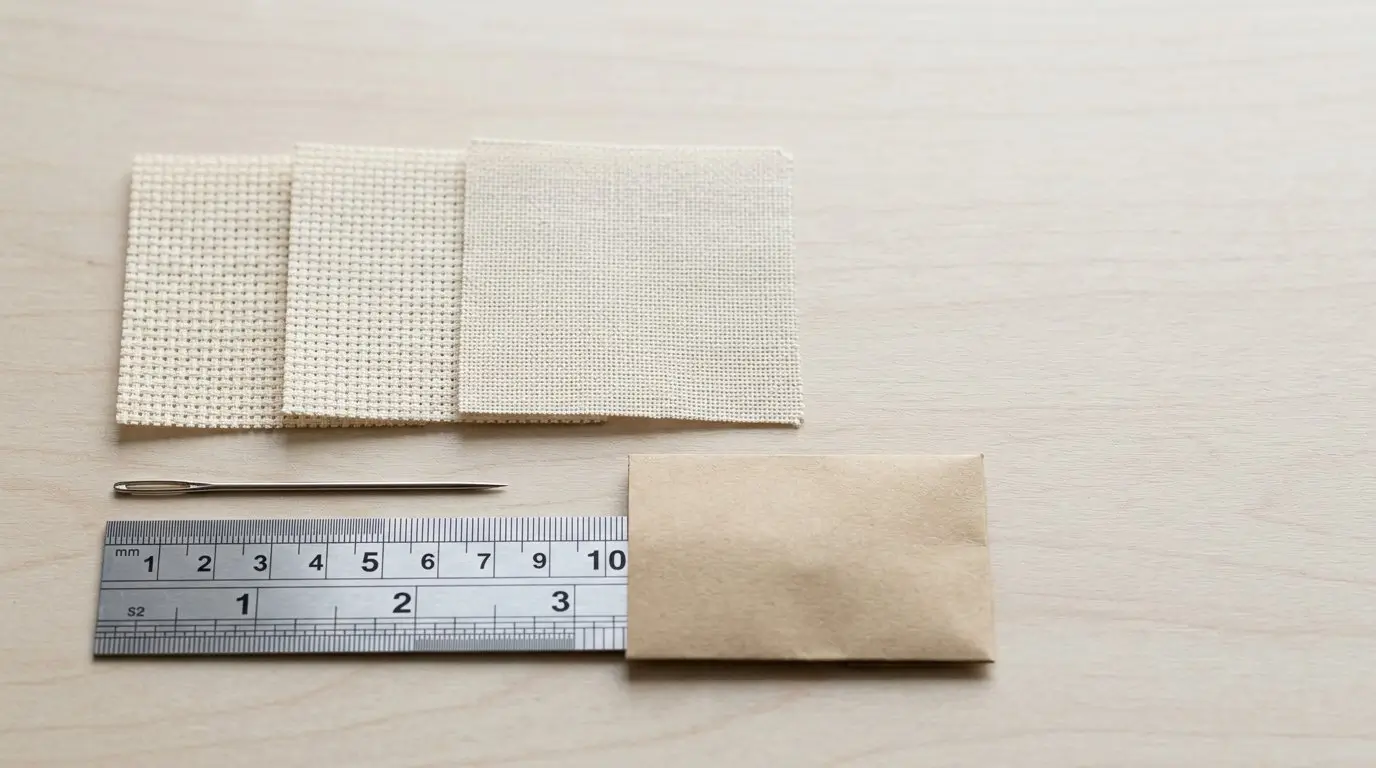
Follow these steps to choose and test your needle before you stitch a large section.
1. Identify your fabric count
Start by checking the fabric packaging, kit label, or pattern notes. If the count is not listed, you can count the squares or threads across one inch of fabric.
For Aida, count the visible squares. For evenweave or linen, count the threads. If you are stitching “over two” on evenweave, each stitch crosses two fabric threads in each direction.
2. Start with the chart recommendation
Use the fabric-count chart as your first choice. For example:
- 14-count Aida: try size 24
- 16-count Aida: try size 26
- 18-count Aida: try size 28
- 28-count evenweave over two: try size 26
This gives you a sensible starting point without guessing.
3. Check the number of floss strands
Look at the pattern instructions to see how many strands to use. Thread the needle with that exact number.
The needle eye should hold the floss without pinching, scraping, or making a bulky knot of thread at the eye. If the floss is difficult to pull through the eye or begins to fuzz quickly, you may need a needle with a slightly larger eye.
4. Pull the needle through an empty fabric hole
Before stitching, pass the threaded needle through an empty hole in the fabric. You are checking for resistance.
The needle should move through with light pressure. It should not feel like you are punching a new hole, and it should not drag so much that you have to tug hard.
5. Stitch a small test area
Work a few cross stitches in a corner, margin, or scrap of the same fabric if you have one. Watch how the needle behaves.
A good fit will feel smooth and controlled. The floss should follow the needle easily, and the stitches should sit neatly on the fabric.
6. Adjust one size at a time
If the needle feels wrong, change only one size first.
Go smaller if:
- The fabric holes look stretched
- The needle feels too thick
- The needle distorts the fabric as it passes through
- Your stitches leave visible gaps around the holes
Go larger if:
- The needle is very hard to thread
- The floss bunches at the eye
- The thread frays quickly near the needle
- The needle feels too flexible or difficult to control
A helpful rule of thumb: the needle should open the hole just enough for the floss to pass smoothly, then the fabric should settle back around the stitch. Comfort matters too. If your stitches look neat and the fabric is not being damaged, a slightly different size from the chart is perfectly acceptable.
How Needle Size Changes Your Stitches
Needle size affects both how your stitches look and how comfortable the project feels.
If the needle is too large, it may stretch the fabric holes. You might see visible gaps around the stitches, especially on finer Aida, linen, or evenweave. A large needle can also distort the shape of the fabric holes and make each pass feel heavier than it should.
If the needle is too small, the main problem is often at the eye. The floss may be hard to thread, bunch up, or rub each time it passes through the fabric. This can lead to fraying, fuzzy-looking thread, and slower stitching.
The right needle size feels easy but not loose. It enters the fabric hole smoothly, guides the floss through cleanly, and leaves behind neat X-shaped stitches. You should not need to tug hard, and the fabric should not look stretched after the stitch is complete.
Pay attention to the relationship between the needle eye and your floss. The eye should be large enough to carry the thread without scraping it, but the needle shaft should still suit the fabric hole.
Needles also come in different finishes, such as nickel-plated, gold-plated, and other specialty coatings. These can affect feel, especially if you stitch for long sessions, but size and smoothness are usually more important than finish. There is no single coating that is best for every stitcher or every project.
Common Mistakes and When to Change Needle Size
A few common needle mistakes can make cross stitch harder than it needs to be.
One mistake is using a sharp sewing needle for standard cross stitch. Because cross stitch fabric already has holes, the needle should pass between the threads. A sharp needle may pierce the fabric threads instead, which can make stitches look uneven.
Another mistake is choosing by needle length alone. Length can affect comfort, but the size number tells you more about the needle thickness and how it will fit the fabric.
A third mistake is assuming one needle works for every project. A size 24 may be perfect on 14-count Aida but too large for 18-count Aida. Likewise, a size 28 may suit fine fabric but feel frustrating if you are using thicker thread.
Avoid forcing a needle through tight fabric. If you have to pull hard, stop and test another size. Forcing the needle can stretch holes, wear your floss, and tire your hand.
Also remember that very small needles can bend or feel harder to control, especially for beginners. If a size 28 feels too delicate and your fabric can handle it, try a size 26 and compare the stitch appearance.
You may need to change needle size within the same project when:
- Switching from full cross stitches to backstitch
- Adding beads
- Using metallic thread
- Working with specialty fibers
- Stitching a very dense section
- Noticing thread wear or fraying
Metallic threads and specialty fibers often benefit from a needle with a slightly larger eye, but still avoid a needle that damages or enlarges the fabric holes.
Troubleshooting and Final Fit Check
If your needle still does not feel right, use these quick fixes.
- Needle is hard to pull through: Try a smaller needle, check that you are going through the correct holes, and make sure the fabric is not pulled too tightly in the hoop.
- Floss keeps fraying: Try a needle with a larger or smoother eye, use a shorter thread length, and replace any rough or tarnished needle.
- Fabric holes look stretched: Go down one needle size and test again.
- Needle keeps splitting fabric threads: Make sure you are using a blunt tapestry needle and aim for the existing fabric holes.
- Needle is difficult to thread: Try one size larger, use a needle threader, or trim the floss end cleanly before threading.
- Stitches look uneven: Check your tension, confirm the needle is not too large, and make sure the floss is not twisting heavily.
If you have scrap fabric, test changes there first. This is especially helpful with linen, evenweave, metallic floss, unfamiliar kits, or any fabric where the holes are less obvious than Aida.
Replace needles that are bent, rough, tarnished, or difficult to pull through. Even a small rough spot can create drag and wear on your thread.
Before you continue with the full project, do this final fit check:
- The needle passes through existing holes smoothly
- The thread follows without shredding
- The fabric holes are not enlarged
- The stitches sit evenly
- Your hand feels comfortable as you stitch
The simple takeaway: start with the chart, stitch a small test, and adjust one size at a time until the needle feels smooth and the stitches look neat.
FAQ
What size needle is best for 14-count Aida?
A size 24 blunt tapestry needle is the usual choice for 14-count Aida. It fits the fabric holes well for many standard projects, especially when using two strands of embroidery floss.
Should I use a size 24 or 26 needle for cross stitch?
Use size 24 for larger holes, such as 14-count Aida, and size 26 for finer fabrics, such as 16-count Aida or 28-count evenweave over two. If unsure, test both and choose the smoother fit.
Is a tapestry needle the same as a cross stitch needle?
For most cross stitch, yes. A cross stitch needle is typically a blunt tapestry needle. The blunt tip helps it pass through existing fabric holes instead of piercing the fabric threads.
What needle size should I use for 18-count Aida?
Use a size 28 tapestry needle for 18-count Aida. The smaller needle helps pass through the finer fabric holes without stretching them too much.
Can I use a regular sewing needle for cross stitch?
A regular sharp sewing needle is not ideal for standard cross stitch because it can pierce fabric threads. Use a blunt tapestry needle unless your technique specifically requires a sharp point.
Why does my cross stitch thread keep fraying at the needle?
Fraying can happen if the needle eye is too small, rough, or worn. Try a needle with a slightly larger or smoother eye, use a shorter thread length, and replace damaged needles.